 Create Token
Why a Business Launches Its Own Token: Real Use Cases
What a business actually gets from its own token — loyalty, paid access, community, funding, in-app credit — plus the cases where a database is the better tool.
Unilaunch Team10 min read

Key takeaways
- A token is worth it when the thing you're issuing has to leave your database — be transferable, resellable or usable by someone else's app.
- Loyalty points, paid membership, community rewards, in-app credit and partner payouts are the cases that hold up in practice.
- Tokens sold as an investment are regulated as one, so the safe design is access and perks rather than promised returns.
- Most failed brand token projects failed at the product, not the technology — the token has to unlock something people already want.
- If nothing ever needs to move between people, a database row is cheaper, faster and easier to fix.
Contents
- What a token gives you that a database row doesn't
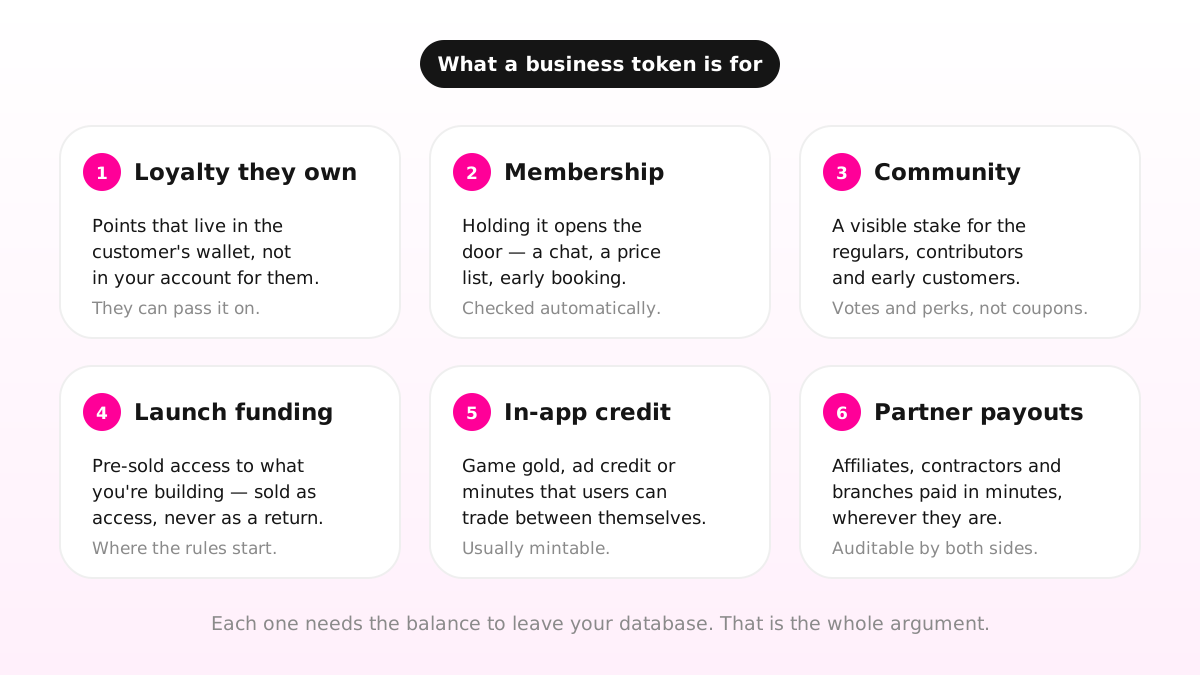
- 1. Loyalty points customers actually own
- 2. Membership and token-gated access
- 3. A community with a stake in the brand
- 4. Funding a launch — and where this gets legal
- 5. In-app and in-game credit
- 6. Paying partners, franchises and freelancers
- What the failures actually teach
- When a token is the wrong tool
- Choosing the shape of your token
- Launching one without a dev team
- Before you commit
Most writing about token launches is aimed at memecoins, where the token is the product. A business asking "should we have a token?" has a different problem: there's already a product, already customers, already a loyalty scheme in a spreadsheet somewhere. The question isn't how to launch — it's what a token would actually do that the current setup doesn't.
The honest answer is that it does one thing, and everything below follows from it: a token moves the thing you issue out of your database and onto a public ledger, where the holder owns it, can transfer it, and can use it without asking you. That's either exactly what you need, or an expensive way to complicate points. This guide covers where it's the first.
What a token gives you that a database row doesn't
A loyalty point in your database is a number you control. You can grant it, revoke it, expire it, and it stops existing the day you switch platforms. That's often fine.
A token is different in four specific ways:
The holder owns it. It sits in their wallet, not in your account for them. You can't quietly take it back — which is exactly why it feels worth more.
It can move. Between customers, into a gift, onto a market. A point that can be given to a friend is a different product from one that can't.
Anyone can read it. Your partner's app, a game, a Discord bot or a ticketing service can check a wallet's balance without an integration with you.
It's countable in public. Supply, holders and transfers are visible, which is the whole basis of trust for anything you promise around it.
1. Loyalty points customers actually own
The classic case. Instead of points locked in an account, a customer earns tokens that live in their wallet: they can hold them, send them to a friend, or sell them to someone who'll use them.
What changes in practice:
Redemption gets a market price. If customers can trade the token, its price tells you what your rewards are actually worth to people — information a closed points system never gives you.
Partners can join without integrating. A neighbouring business can accept your token by checking one balance. No API, no contract between your loyalty vendors.
Points survive your platform. Switching from one CRM to another doesn't erase what customers earned.
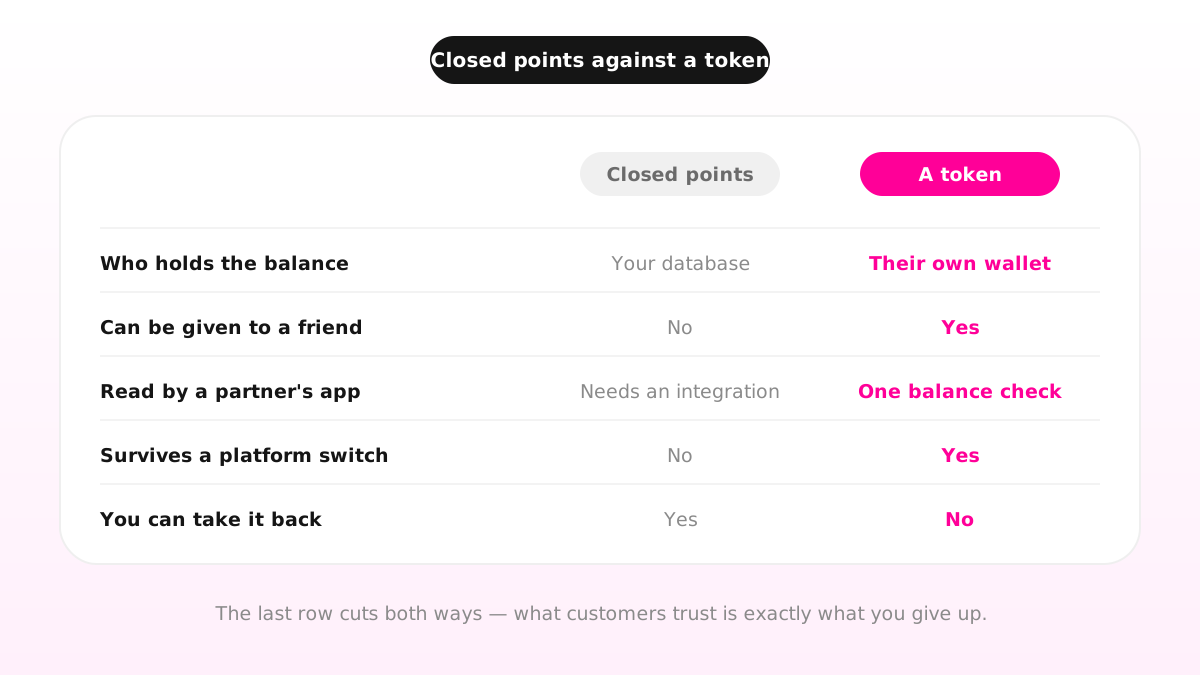
The trade-off is real, though: a tradable reward can be sold by people who never intended to be your customers, and its price will move for reasons that have nothing to do with you. If that would break your economics — a fixed "100 points = one free coffee" promise, say — price the redemption in your own terms, not in the token's market value.
2. Membership and token-gated access
Here the token isn't a reward, it's a key. Holding it — or holding a certain amount of it — unlocks something: a private community, a members' price list, early booking, a course, a tool, a physical door at an event.
This is the cleanest business case, because the value is defined entirely by you and needs no market at all. The token is a membership card that:
can be checked automatically by a Discord or Telegram bot, a website, a POS or an app;
can be resold by the member when they're done, which makes a pricier tier easier to sell in the first place;
doesn't need you to run an accounts system for a small group.
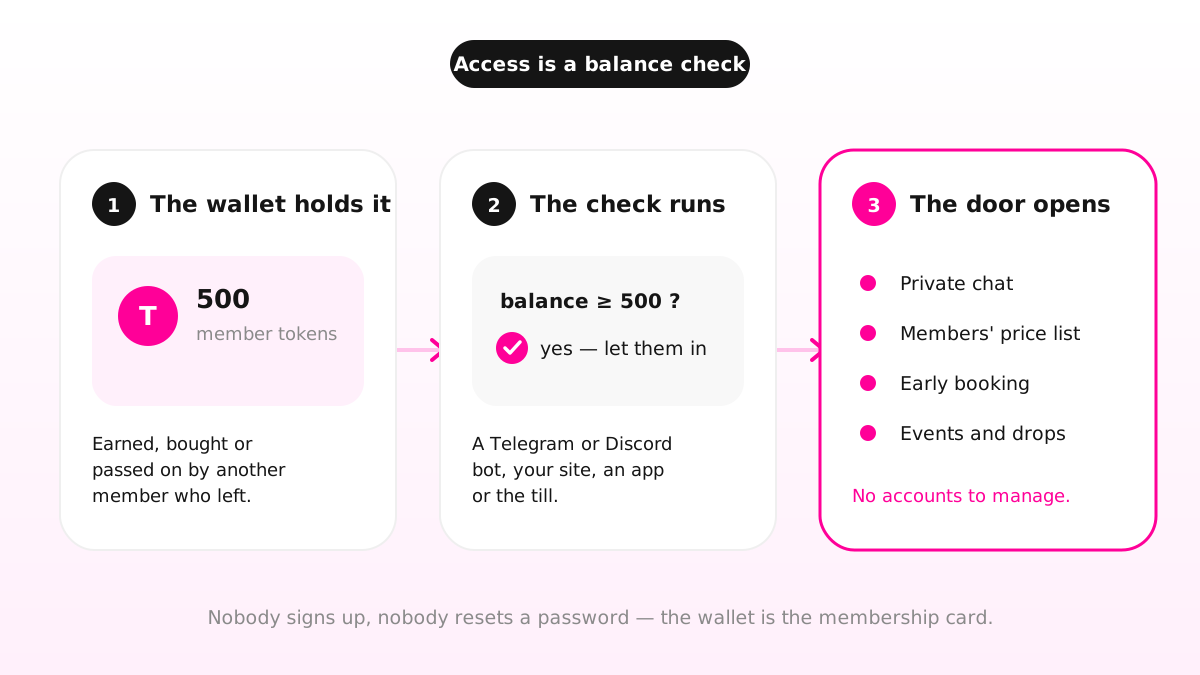
The design question is fungible tokens versus NFTs. A fungible token is right when access is a threshold ("hold 500 to enter") and when members may hold different amounts. An NFT is right when each membership is a distinct, countable seat — numbered, limited, individually revocable-by-design. Many businesses get further than they expect with a plain fungible token and a threshold.
3. A community with a stake in the brand
Creators, clubs, local venues and niche brands use a token to make participation visible: it goes to the people who showed up — early customers, contributors, volunteers, beta testers — and it gives them something that isn't a discount code.
Used well, it's a way to say who the regulars are. Football clubs have run fan tokens on this logic for years, with polls and perks attached to holding. Used badly, it's a currency nobody wants that quietly tells your best customers their reward is worthless.
The difference is whether holding the token gets you anything you couldn't buy. Votes on things that genuinely change (a flavour, a tour stop, a feature), access that isn't for sale, a share of limited stock. If the perk is "10% off", you invented a coupon with extra steps.
4. Funding a launch — and where this gets legal
Selling tokens ahead of a product is how a lot of businesses first think about this: pre-sell the future, fund the build. It's also where the rules bite.
The line is roughly this: a token sold as an investment, where buyers expect to profit from your work, is treated as a security in most jurisdictions no matter what you call it. A token sold as access to a product — a credit, a seat, a membership — is generally a different thing.
In the US, the Howey test is still the operative standard, and it looks at the substance of what you sold, not the label. Legislative attempts to redraw the line stalled in the Senate in September 2026, and the SEC has been filling the gap with rulemaking of its own.
In the EU, MiCA requires a standardised white paper for a public offer of a crypto-asset, notified to a regulator before trading rather than approved by it, with exemptions that a small business often falls inside — for example offers under €1 million over twelve months, or fewer than 150 people per member state.
None of this is legal advice, and the practical takeaway is simple: design your token as access to what you sell, not as a return on what you build, and get a local lawyer to look at it before you take money. Pre-selling credit for your own service is a well-trodden path. Promising appreciation is a different business with a different licence.
5. In-app and in-game credit
If your product already has an internal currency — game gold, ad credits, compute time, minutes — a token turns that closed balance into something players or users can trade between themselves, carry to a partner game, or cash out.
Two things make this work: the credit has to be genuinely spendable on something real inside your product, and you need to be able to issue more as people buy it. A fixed supply is a bad fit for a currency that tracks sales; a mintable token, controlled by your treasury, is the usual answer.
Be careful with the reverse case. If users can buy in and cash out at a floating price, you've built a market with your product attached, and your support queue becomes a trading desk.
6. Paying partners, franchises and freelancers
The least glamorous use, and often the most immediately useful. A token — or, more often, a stablecoin balance plus your own token for incentives — settles in minutes, at a fee that doesn't scale with the amount, to anyone with a wallet.
Where this earns its keep:
Cross-border payouts to contributors, affiliates and contractors in places where a bank transfer takes days and a card payout isn't available.
Franchise and partner networks, where a shared token turns internal accounting between branches into transfers anyone can audit.
Referral and bonus programmes whose payouts you want to be provable, automatic and visible to the people earning them.
What the failures actually teach
Big brand token projects have a visible graveyard, and it's worth reading before you copy one. Starbucks closed its Odyssey NFT programme in March 2024 and, by early 2026, had rebuilt Rewards as a conventional tiered scheme. Nike wound down RTFKT, the studio behind its digital collectibles, and faced a class action from holders in 2025. Meanwhile, programmes that kept going — Nike's .SWOOSH, Lufthansa's Uptrip, brands putting physical products in shops on the back of a digital community — tend to have one thing in common.
They attach the token to something people already wanted. The failures mostly sold the token itself: the reward for holding was the hope that holding would be rewarded. When that stopped being interesting, so did the programme.
So the test for your own idea is blunt. Take the token away — is what's left still worth buying? If yes, the token can make it easier to own, share and prove. If no, the token isn't the missing piece.
When a token is the wrong tool
Skip it — or at least postpone it — when:
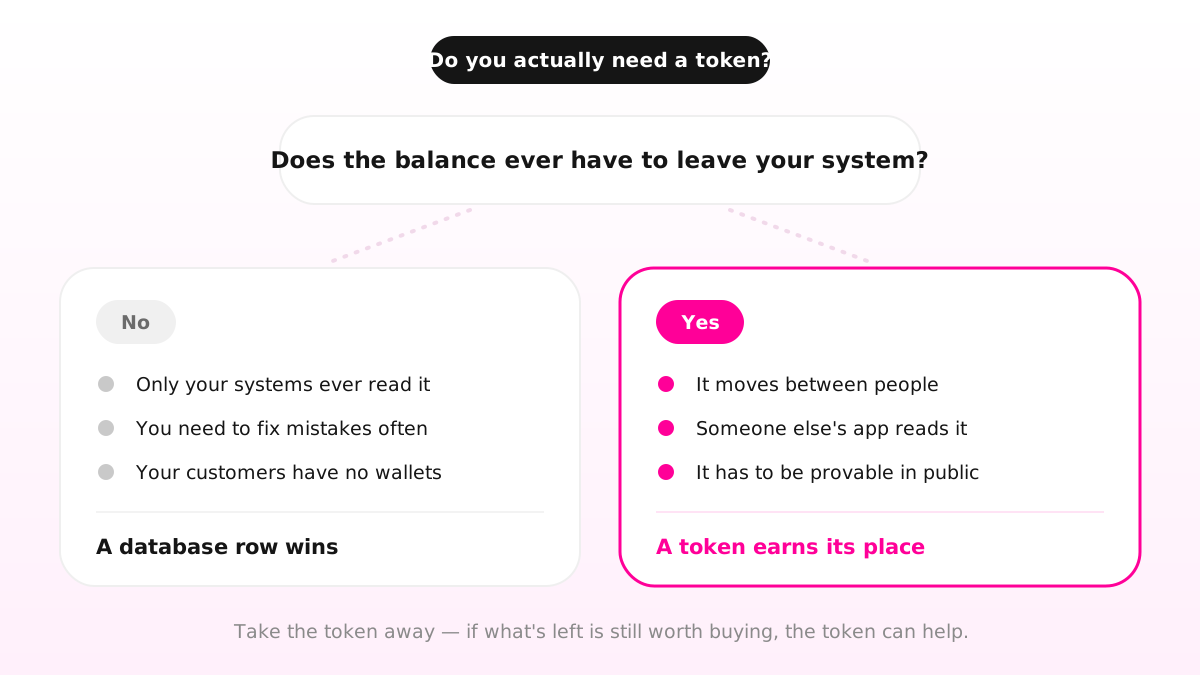
Nothing ever moves between people. A balance only you read is a database row. Cheaper, faster, and fixable when it's wrong.
You need to reverse mistakes. On-chain transfers are final. A support team that regularly refunds, adjusts and corrects will feel that immediately.
Your customers have no wallets. Every extra step costs you people. Token-gating a mainstream audience means building the wallet onboarding too.
The price moving would break your pricing. Denominate in your own prices, or don't put the reward on a market.
You can't answer "what is it for?" in one sentence. That's not a technology problem, and launching won't solve it.
Choosing the shape of your token
Once the use case is clear, four decisions cover most of it:
| Decision | For a business, usually |
|---|---|
| Fungible or NFT | Fungible for points, credit and thresholds; NFT for numbered seats and unique items |
| Fixed or mintable supply | Fixed when it's a membership run; mintable when it tracks ongoing sales or rewards |
| Free or sold | Earned and given for loyalty; sold only after you've checked what selling makes it, legally |
| Traded or not | A public pool gives it a price and a market — useful for community tokens, unnecessary for a closed membership |
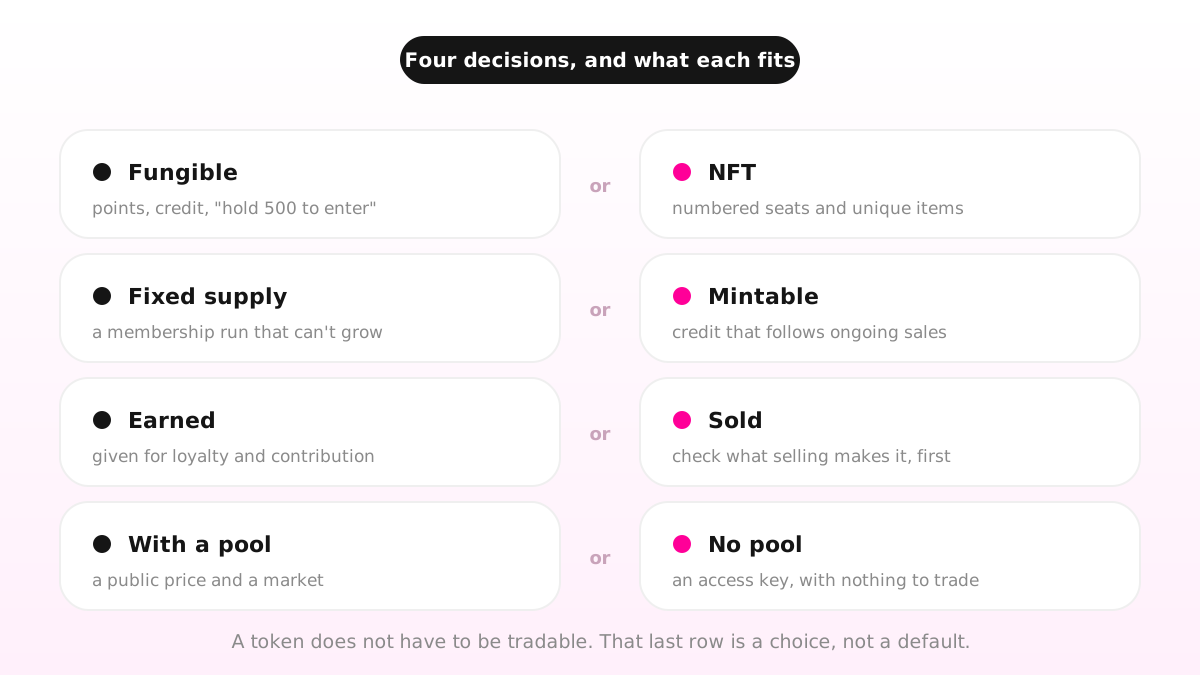
The last row is the one people assume is compulsory. It isn't: a token can exist purely as an access key, with no pool, no price and no market. If you do want it tradable, our guide to adding liquidity and listing on a DEX covers what that involves.
Launching one without a dev team
This is the part that used to need a contract developer and a fortnight. On Unilaunch it's a form: name, symbol, supply, logo and links, on Solana, Ethereum, BNB Chain, Base, Arbitrum, Polygon, Avalanche, Blast or Robinhood Chain.
What's worth knowing for a business launch specifically:
Mintable or not is a choice at creation. Keep minting for a credit that tracks sales; leave it off for a fixed membership run, where "no more can ever be created" is the point.
Multi-wallet distribution splits the supply across up to 10 wallets in the same transaction — treasury, rewards pool, team, partners — so the allocation is on-chain from day one instead of being explained in a blog post.
The pool is optional. Turn it on if the token should trade; leave it off for an internal or access-only token.
EVM contracts are verified automatically, and on Solana the authorities can be revoked at creation — which matters more for a business than for anyone, because your customers are the ones being asked to trust it. See how to prove your token isn't a scam for what they'll check.
Before you commit
| Question | Why it decides the project |
|---|---|
| What does holding it get someone? | If you can't say it in a sentence, nothing else matters |
| Does the balance need to leave your system? | This is the whole argument for a token over a database |
| Who can create more, and when? | Fixed supply and mintable supply are different products |
| Are you selling it, or giving it? | Selling is where the legal questions start |
| What happens if the price moves? | Price your redemptions so a market can't break them |
| How does a non-crypto customer use it? | Wallet onboarding is part of your product now |
A token is a good tool for a narrow set of jobs: proving what someone holds, letting them move it, and letting other systems read it without you. Start from the job, not from the launch.
Know what yours is for? Create your token with the supply, permissions and distribution set in one step, or take the Knowledge Base route for the walkthrough.
- #business tokens
- #loyalty program
- #token-gated access
- #community
- #utility token
- #MiCA
- #use cases