
 Create Token
Create a Token in Remix or With a Builder: An Honest Comparison
Remix or a no-code token builder? What each costs, how long it takes, what can go wrong, and how to check a builder's contract before you trust it.
Unilaunch Team7 min read

Key takeaways
- Remix is free and gives you full control, but every step after writing the code is yours too — deploying, verifying, listing and the pool.
- A builder costs a fee on top of gas and buys you speed, a tested template and the steps around the contract done for you.
- Remix only covers EVM chains. A Solana token is made with other tools, or with a builder that supports Solana.
- The real risk with a builder is trusting code you didn't write — so check that it's verified and read what the owner can do.
- A standard token is a builder's job. Custom logic — vesting, staking, unusual fees — is where Remix and your own code earn their keep.
Contents
There are two ways most people make a token on an EVM chain. You can open Remix, the browser-based Solidity IDE, write or paste a contract and deploy it yourself. Or you can use a token builder: fill in a form, pay a fee, and get a deployed token back.
Builders like to say Remix is only for developers. Developers like to say builders are for people who'll get scammed. Both are partly right, and neither answer helps you decide. This guide compares them on what actually differs — cost, time, control, and what can go wrong — so you can pick the right one for the token you're making.
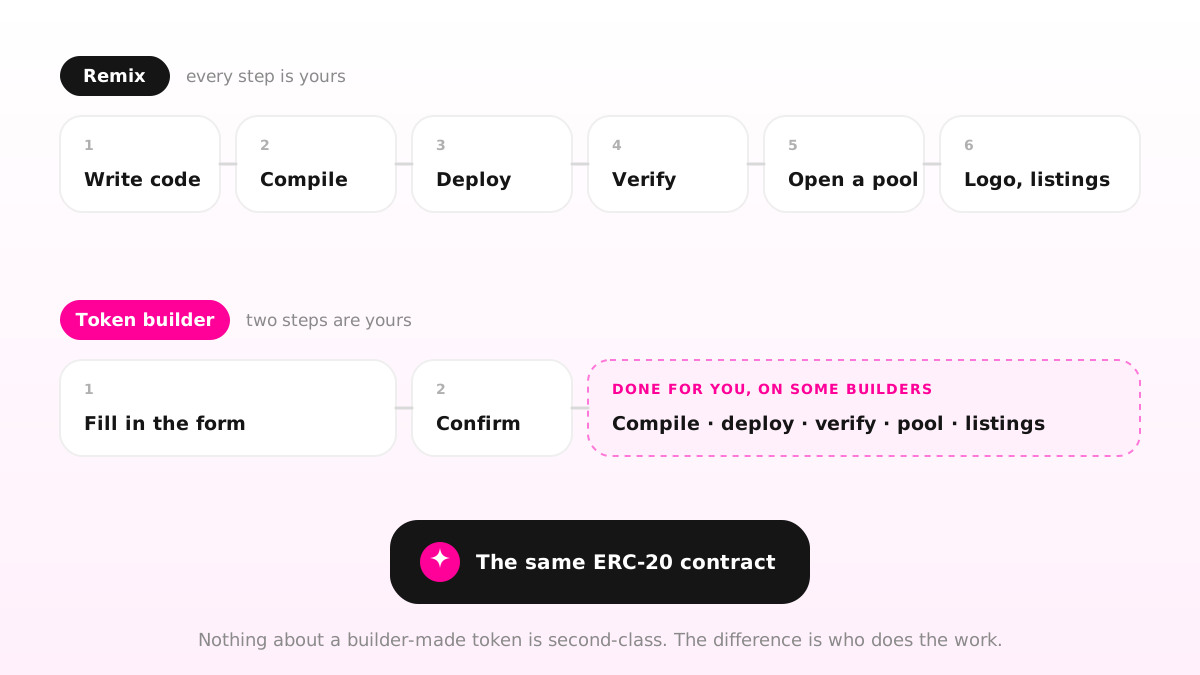
The same token, two routes
On Ethereum, BNB Chain, Base and every other EVM chain, a token is a contract. Whether you deploy it from Remix or a builder deploys it for you, the end result is the same kind of object: an ERC-20 contract at an address, run by the same chain, readable by the same wallets and explorers. Nothing about a builder-made token is second-class.
What differs is who does each step, and who you have to trust.
Creating a token in Remix, step by step
If you've never used it, this is what the Remix route really involves.
1. Get the contract. Almost nobody writes an ERC-20 from scratch. The OpenZeppelin Contracts Wizard generates one from checkboxes — mintable, burnable, pausable, ownable — and opens it straight in Remix. A minimal fixed-supply token looks like this:
// SPDX-License-Identifier: MIT
pragma solidity ^0.8.27;

import {ERC20} from "@openzeppelin/contracts/token/ERC20/ERC20.sol";

contract MyToken is ERC20 {
    constructor() ERC20("My Token", "MTK") {
        _mint(msg.sender, 1_000_000 * 10 ** decimals());
    }
}
That 10 ** decimals() matters. ERC-20 balances are whole numbers in the token's smallest unit, with 18 decimals by default, so leaving it out gives you a supply of one millionth of a millionth of a token. It's the most common first mistake.
2. Compile it. Pick a compiler version that matches the pragma, and note the settings you used — optimisation on or off, the number of runs, the EVM version. You'll need them again in step 4.
3. Deploy it. In Deploy & Run Transactions, choose your browser wallet as the environment (older tutorials call it "Injected Provider"), check that the wallet is on the network you mean, and press Deploy. Your wallet asks you to confirm, you pay the gas, and the contract address appears.
4. Verify the source. Remix's Contract Verification plugin can submit your code to Sourcify, Etherscan, Blockscout and Routescan; Etherscan needs an API key. The compiler version and settings have to match the deployment exactly, or verification fails with an error about bytecode that doesn't match. Until it's verified, buyers see an unreadable contract — and treat it as a red flag.
5. Everything after the contract. The token now exists, but nobody can see its logo, and nobody can buy it. You still need to create a liquidity pool on a DEX and fund it, and submit the token's logo and links to DexScreener and the explorers. None of that happens in Remix.
6. Repeat per chain. Launching on Base and BNB Chain as well? That's another deployment, another verification and another pool on each.
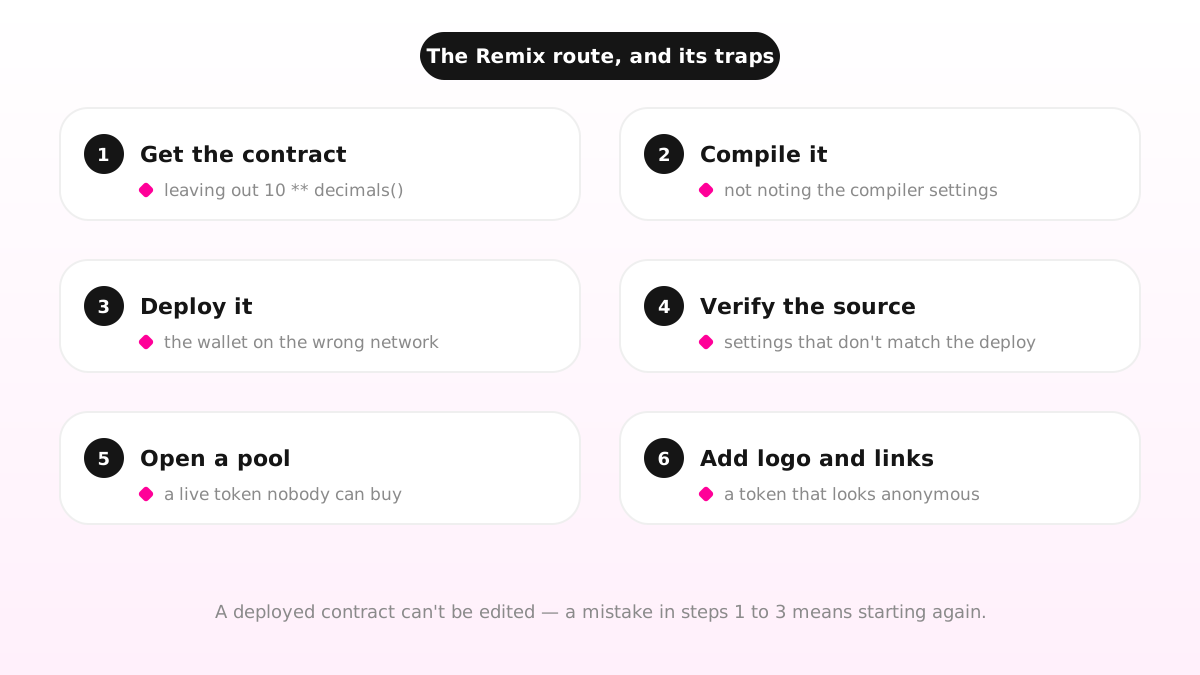
None of this is hard for someone who has done it before. It's a lot of small, permanent decisions for someone who hasn't — and a deployed contract can't be edited, only replaced.
What a builder does instead
A builder runs the same steps behind a form. You enter the name, symbol, supply and logo, tick the features you want, and confirm one transaction from your own wallet. The builder's contract template is deployed with your settings.
What you pay for is everything around the contract:
A tested template. The decimals, the supply maths and the permission logic are written once and reused, rather than assembled fresh each time.
Verification done for you, so the contract is readable on the explorer from the first block.
The steps Remix leaves out — on some builders, the liquidity pool, the metadata and listing submissions happen in the same flow.
Several chains with one form, including Solana, where Remix doesn't apply at all.
Side by side
| Remix | Token builder | |
|---|---|---|
| What you pay | Gas only | Gas plus a service fee |
| Time to a live token | An hour to an afternoon the first time | A few minutes |
| Skills needed | Solidity basics, compiler settings, verification | Filling in a form and confirming in a wallet |
| Control over the code | Total — anything Solidity can express | The features the builder offers |
| Who you trust | Your own code, and OpenZeppelin's | The builder's template |
| Verification | You do it, and it can fail on settings | Usually automatic |
| Pool, logo, listings | Separate tools, done by you | Often in the same flow |
| Solana | Not supported | Depends on the builder |
| Fixing a mistake | Deploy a new contract | Deploy a new token |
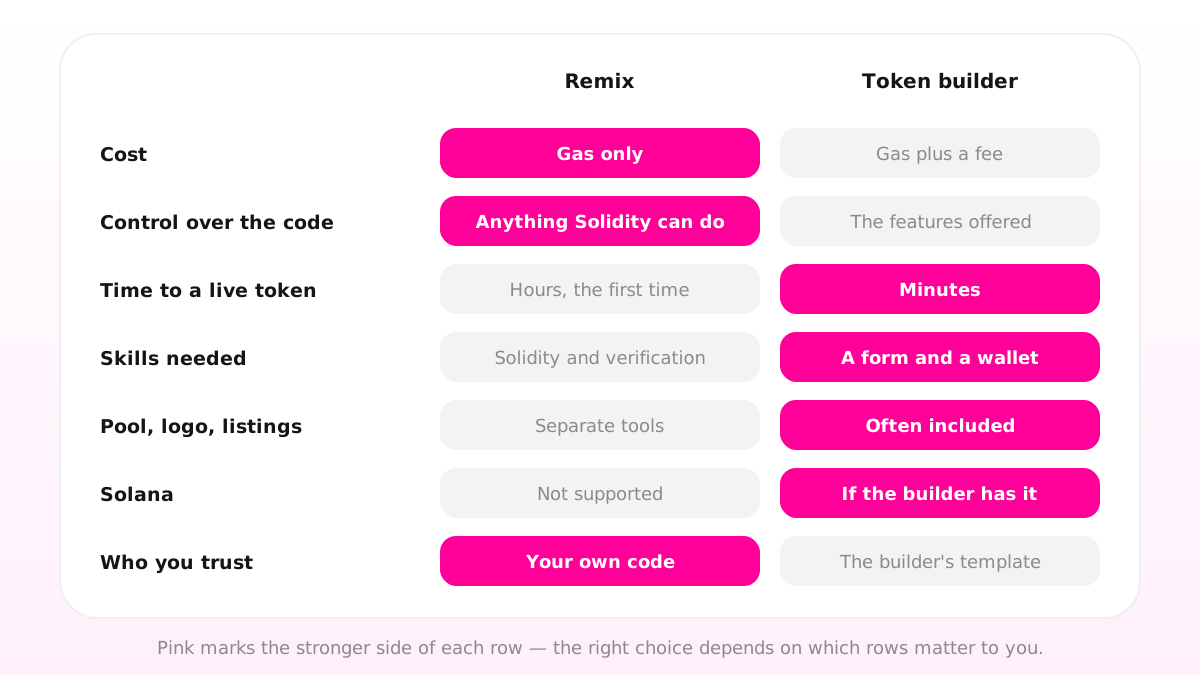
The cost row is less one-sided than it looks. Remix is free, but your time isn't, and a failed first attempt costs a second round of gas. On Ethereum mainnet that's real money; on Base or BNB Chain it's cents, which makes Remix far cheaper to learn on those chains — or on a testnet like Sepolia, where gas is free.
The honest case against builders
Builders have a trust problem, and it's earned. The same no-code convenience that helps honest creators has been packaged into kits for scammers, which launch tokens with hidden mint functions, sell blocks and owner switches that only activate once trading picks up.
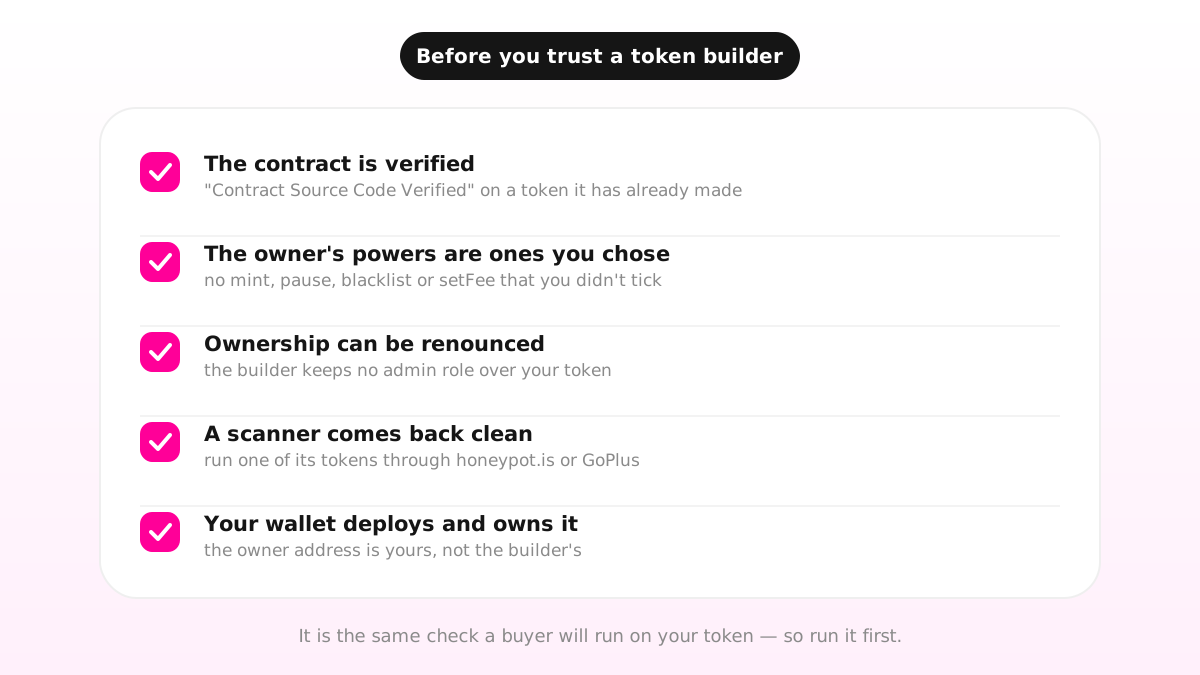
That doesn't make builders unsafe. It means you should check one the way a buyer would check your token — before you pay, not after:
Is the contract verified on the explorer? Open a token the builder has made and look for "Contract Source Code Verified". If the code isn't public, you can't know what it does.
What can the owner do? Read the verified code, or the explorer's Write Contract tab, for functions like
mint,pause,blacklistorsetFee. Every one should be something you chose, not something the template adds.Can ownership be renounced? If the builder keeps an admin role over tokens it deploys, the token isn't fully yours.
Does a scanner agree? Run a builder-made token through honeypot.is or GoPlus. A clean template comes back clean.
Are you the deployer and owner? The transaction should come from your wallet, and the owner should be your address, not the builder's.
The honest case against Remix
Remix has its own risks, and they're about you rather than a third party:
Permanent typos. A wrong name, symbol, decimals or supply is on-chain forever. The only fix is a new contract — and telling everyone the old address is dead.
Powers you didn't mean to keep. Tick "Mintable" in the Wizard and forget to renounce, and your token carries an owner-only mint that every scanner will flag.
Unverified by accident. A verification that failed on compiler settings and was never retried leaves a perfectly honest token looking like a scam.
The launch is only half done. A deployed, verified contract with no pool and no logo is invisible to traders. Many first Remix launches stall right here.
Which one should you use?
Use Remix if you need logic no builder offers — vesting, staking, custom fee routing, an unusual supply schedule — or if learning Solidity is part of the point. Start on a testnet, keep a note of your compiler settings, and verify before you announce anything.
Use a builder if you want a standard token — fixed or mintable supply, burnable, perhaps a transfer fee — live, verified and tradable today, on one chain or several. Check the builder first, using the list above.
Use both if you're unsure: deploy a test version from Remix on Sepolia to understand what's happening under the hood, then launch the real one wherever gets it right with the least risk.
Where Unilaunch fits
Unilaunch is a builder, so all of the checks above apply to it, and it's built to pass them:
Your wallet deploys the token, and you own it. You confirm the transaction yourself, and the token is created on Solana, Ethereum, BNB Chain, Base, Arbitrum, Polygon, Avalanche, Blast or Robinhood Chain.
Only the powers you pick are written in. Burnable, Mintable and Pausable are choices at creation; anything you leave off isn't in the contract at all. Ownership can be renounced in the same flow, and on Solana mint, freeze and update authority can be revoked.
EVM contracts are verified automatically on the chain's explorer, so the source is readable from the start.
The steps after the contract are included. The liquidity pool can be set up in the same flow, and token info goes to DexScreener, CoinGecko and CoinMarketCap.
If you're weighing up the two, our guides on how to launch a token on any chain and how to prove your token isn't a scam cover what both routes have to get right.
The short version
| If you need… | Choose |
|---|---|
| Custom contract logic | Remix |
| To learn how ERC-20s work | Remix, on a testnet |
| The lowest possible cost on a cheap chain | Remix, if your time is free |
| A standard token, live today | A builder |
| Solana as well as EVM chains | A builder that supports both |
| Pool, verification and listings without extra tools | A builder that includes them |
Both routes end at the same kind of contract. Pick the one where you're least likely to make a permanent mistake — and whichever you choose, verify it.
Ready to try the builder route? Create your token with the powers, pool and verification set in one step, or read the Knowledge Base first.
- #Remix
- #Solidity
- #ERC-20
- #OpenZeppelin
- #token builder
- #no-code
- #contract verification